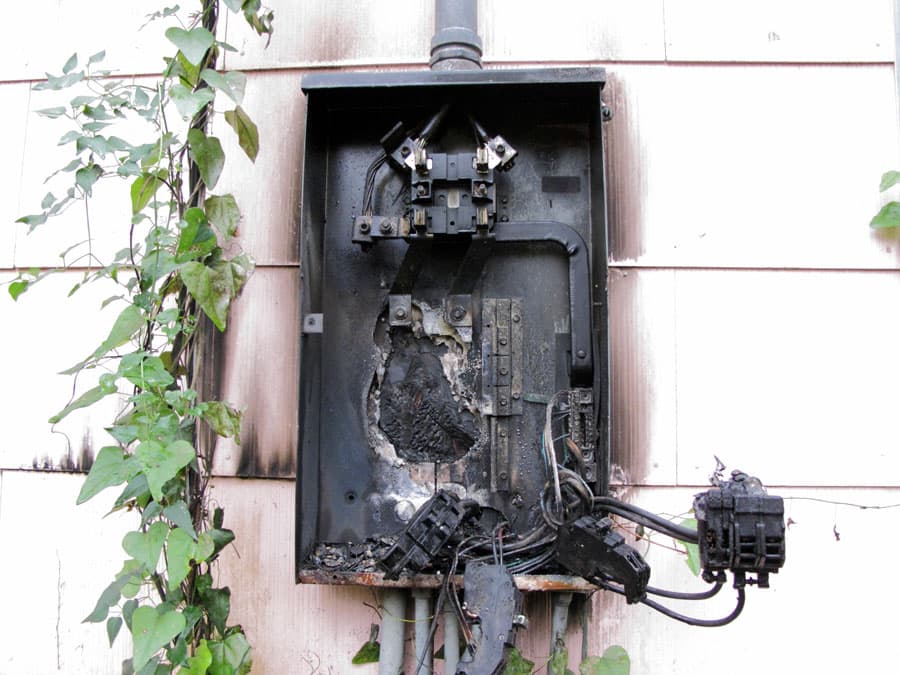
Federal Pacific Stab-Lok panels. Zinsco panels. Aluminum branch wiring. Three documented fire and shock hazards still in service in tens of thousands of older DFW homes — and routinely missed in fast inspections. Here's what Sola Fide flags, and what to do about it.
Three electrical hazards from the 1960s through the 1980s remain in service in tens of thousands of homes across the Rockwall and Greater DFW area. Federal Pacific Stab-Lok panels. Zinsco panels. Aluminum branch-circuit wiring. Each has a documented track record of fires, shocks, or both — and each is routinely overlooked by inspectors who don't open the panel or know what to look for.
Sola Fide Home Inspections flags all three on every general home inspection in Rockwall, Heath, Fate, Wylie, Sachse, Garland, Mesquite, and Greenville. If you're buying any home built between 1955 and 1985, this is the inspection finding most likely to actually save your life — not just your wallet.
Federal Pacific Stab-Lok: The Panel That Doesn't Trip
Federal Pacific Electric (FPE) Stab-Lok panels were installed in millions of U.S. homes from the late 1950s through the 1980s. Independent testing in the 1980s and 1990s — most notably by Aronstein and Lipton — found that a meaningful percentage of FPE Stab-Lok breakers fail to trip on overload or short circuit. The Consumer Product Safety Commission investigated, and class-action settlements followed, but no recall was ever issued. The panels remain in service.
The hazard is straightforward: a breaker that doesn't trip when it should allows current to keep flowing through an overloaded or shorted circuit, heating wiring beyond its insulation rating, until something — a wall stud, a wire nut, a connection — ignites.
How to spot it. Federal Pacific Stab-Lok panels have a distinctive front panel with thin, individual breakers whose handles are marked with red, yellow, or black tabs. The label on the panel door typically reads "Federal Pacific Electric" or "FPE Stab-Lok." Curtis identifies these panels visually and documents them on every inspection.
The recommendation. Replacement. Federal Pacific Stab-Lok panels cannot be reliably retrofitted with safer breakers. The standard remediation is full panel replacement by a licensed electrician. It's a significant expense that varies with service size and panel location, but it costs far less than the fire risk it removes.
Zinsco / GTE-Sylvania: Same Story, Different Brand
Zinsco panels (also branded as GTE-Sylvania, Sylvania-Zinsco, and Magnetrip) were manufactured from the 1950s through the 1970s and have substantially the same failure mode: breakers that fail to trip and bus bars that fuse to breakers under heat, making it impossible to safely remove the breaker for service.
How to spot it. Zinsco panels often have colorful breaker handles — red, blue, green, and yellow. The panel label may read "Zinsco," "GTE-Sylvania," or "Sylvania." Curtis documents Zinsco panels with the same severity rating as Federal Pacific.
The recommendation. Replacement, same as FPE. Costs are similar.
Aluminum Branch-Circuit Wiring: A Different Failure Mode
In the late 1960s and early 1970s, copper prices spiked, and many builders used aluminum wiring for branch circuits in residential construction — typically the entire 15A and 20A receptacle and lighting circuits in the home. Aluminum behaves differently from copper at electrical connections:
- It expands and contracts more with thermal cycling, loosening connections
- It oxidizes when exposed to air, creating high-resistance connections that heat under load
- It's softer than copper, deforming under terminal screw pressure
- Connections to copper devices (outlets, switches) develop galvanic corrosion
The result: aluminum branch wiring is associated with elevated rates of overheating connections, scorched receptacles and switches, and electrical fires. The CPSC has documented the risk extensively.
How to spot it. Aluminum wire is silver-colored where copper is reddish. In the panel, branch circuit conductors marked AL or AlumaConn are aluminum. At outlets and switches, marker tape or telltale connection methods may be visible.
The remediation options.
- Full rewire to copper — most expensive (often a five-figure job for a typical home), most permanent
- CO/ALR rated devices — replacement of every outlet and switch with a CO/ALR-rated device designed for direct aluminum termination (a moderate cost)
- AlumiConn or COPALUM connectors — pigtail connectors that join the aluminum branch to a short copper lead at every device. AlumiConn is more accessible to electricians; COPALUM requires special tooling. (Cost falls between the other two options.)
The AlumiConn pigtail approach is the most common remediation in DFW. Curtis documents whether prior remediation has been performed and flags any aluminum connections that don't appear to have been remediated.
Other Electrical Findings Common in Older DFW Homes
Beyond the three major hazards, Curtis routinely documents:
- Knob-and-tube wiring in pre-1950 homes (rare in Rockwall, more common in Dallas proper)
- Ungrounded receptacles and "cheater" three-prong adapters
- Missing GFCI protection in kitchens, baths, garages, exteriors, and laundry areas
- Missing AFCI protection on bedroom circuits in homes built or rewired after the AFCI requirement
- Double-tapped breakers — two wires under a single breaker terminal not rated for it
- Reverse polarity at receptacles
- Bonding and grounding deficiencies at the main service panel and water service
- Improperly sized service entrance for the home's actual load — frequently undersized in homes where additions or major appliances were added without service upgrades
What a Sola Fide Electrical Inspection Covers
Every general home inspection at Sola Fide includes a thorough electrical evaluation:
- Service entrance — overhead or underground service, weather head condition, service entrance conductors
- Main panel — manufacturer (every panel is identified and flagged if hazardous), bus condition, breaker condition, double-taps, knockouts, and bonding
- Sub-panels — same scope as the main, plus four-wire feeder verification
- Branch circuits — wiring type (copper, aluminum, knob-and-tube), GFCI/AFCI protection, grounding
- Receptacles and switches — operation, polarity, GFCI test where required, condition
- Smoke and CO alarms — presence, age, and operation
- Thermal imaging on the panel — included on every inspection — identifies overheating breakers and connections that aren't yet visibly failing
This level of documentation is exactly what an experienced Rockwall buyer's agent is looking for when they refer an inspector — verifiable, photographed, and useful for repair negotiation.
Frequently Asked Questions
Will my insurance company drop me if I have a Federal Pacific panel? Many homeowner insurance carriers in Texas now decline to write or renew policies on homes with FPE Stab-Lok or Zinsco panels. If your inspector identifies one, expect either a replacement requirement before closing or a substantially higher premium until the panel is replaced.
Is aluminum wiring an automatic deal-killer? No — it's a documented and remediable defect. Tens of thousands of DFW homes have either been remediated already or are insurable with proper devices in place. The key is documenting current condition, prior remediation history, and the cost to bring the system to current standards before closing.
How can I tell if my panel was upgraded? A modern panel will be labeled by the current manufacturer — Square D, Eaton, Siemens, GE, Cutler-Hammer. Federal Pacific and Zinsco panels look distinctive and pre-date most current model identifiers. Curtis identifies the panel manufacturer on every inspection.
What about Challenger panels? Challenger Electric panels manufactured between roughly 1985 and 1992 have a known issue with bus bar overheating and have been subject to a separate CPSC investigation. Curtis flags Challenger panels and recommends evaluation by a licensed electrician.
Does thermal imaging actually find electrical problems? Yes — and they're some of the most consequential thermal findings on any inspection. Curtis scans every accessible panel under load. Hot breakers, hot lugs, and hot wire terminations show up clearly on infrared and indicate connections that are heading toward failure.
Schedule your Rockwall, Heath, Fate, or DFW home inspection with Sola Fide Home Inspections today — call Curtis Oakley, InterNACHI Certified Master Inspector (TREC #25546), at 469-383-2362 or book online — and find out what's behind the panel cover before you close.